The post Looking Backward, Looking Forward: Honouring Women in Engineering appeared first on Ontario Society of Professional Engineers.
]]>
Each year, December 6th stands as a solemn reminder of the devastating events that unfolded at Polytechnique Montréal in 1989. On that tragic day, 14 women lost their lives in an act of antifeminist violence, with 12 of them being engineering students. This day, marking its 35th anniversary, is not only a time to mourn their loss but also a call to action to combat gender-based violence.
This year, Western Engineering embarked on an inspiring initiative—a video series featuring 12 multi-generational pairs of women engineers. These mothers and daughters shared their responses to the events of December 6th, the challenges they faced, and their aspirations for a more inclusive and equitable future in engineering. Through their stories, they bridge the past and future, demonstrating the strength and passion driving progress in the field. Their reflections not only honour those we’ve lost.
Voices from the Series
Mary Wells, McGill University (Class of 1987) & Patricia Owen, McMaster University (Class of 2024)
Emily Moore, Queen’s University (Class of 1992) & Evelyn Cudmore, McMaster University (Class of 2024)
Christine Haas, Western University (Class of 1993) & Alyssa Haas, McMaster University (Class of 2021)
Belinda Wilson, Technical University of Nova Scotia (Class of 1990) & Katherine Wilson, Western University, (Class of 2019)
Annette Bergeron, Queen’s University (Class of 1987) & Noelle Bergeron, McGill University (Class of 2019)
Susan Goertz, Western University (Class of 1996) & Samantha Goertz, Western University (Class of 2024)
Join the Conversation
We encourage everyone to watch and share these stories to amplify their impact. Reflect, take action, and be part of the change. Together, we can create a future where engineering—and society as a whole—is safe, inclusive, and equitable for all.
The post Looking Backward, Looking Forward: Honouring Women in Engineering appeared first on Ontario Society of Professional Engineers.
]]>The post 35 Years After the Montreal Massacre: Reflecting on Gender Equity and Discrimination in Engineering appeared first on Ontario Society of Professional Engineers.
]]>
By: Shivani Nathoo, P.Eng., EDIA Task Force Chair and Naomi Williams, P.Eng., PMP, Architectural Project Leader for the Town of Oakville
December 6th marks the 35th anniversary of the Montreal Massacre, the day when an armed man killed 14 woman and injured 13 other individuals at Polytechnique Montréal. The shooter’s focus on women in engineering left a profound impact on the engineering community, causing us to come together and reflect on gender-based violence in the profession every year since. Now, 35 years on, what can we say about gender equity and discrimination in the field and in society as a whole?
Engineering undergraduate enrolment has diversified significantly, with women making up 27% of students in engineering programs in Ontario. However, according to Professional Engineers Ontario, despite the rise in women in engineering education, the proportion of newly licensed professional engineers who are women has stagnated around 19% in Ontario since 2018.
In a study of engineering graduates in Canada, Chan et al found that women were more likely than men to go the non-traditional path and move away from engineering into another discipline. Breaking this down further, racialized women were almost twice as likely to go the non-traditional path than white women.
It is difficult to pinpoint one specific reason causing women to leave the field. Nor is it the same reason for all women. While women in engineering are all at risk of misogyny and discrimination, a women’s experience in engineering will also be impacted by her other identities. For example, Chan et al found that racialized women had a weaker sense of belonging than others in engineering but did not notice a similar discrepancy with white women.
According to Statistics Canada, “49% of LGB+ women and 35% LGB+ men experienced unwanted sexual behaviours in the workplace… more than among heterosexual women (28%) and men (16%).” Research from Reidy, Baumler, and Temple found that for STEM majors that had gender parity, women were more likely to experience sexual violence than women in other majors. Further study also revealed that, women of a sexual minority (i.e. LGB+) were more likely to experience sexual violence than heterosexual women in the same program.
Notably absent from the statistics above is information on other gender minorities, including transgender, and non-binary people, who are significantly more likely to experience gender based violence in general, and unwanted sexual behaviours in the workplace than their cisgender counterparts. Some of the studies and data sources above are not collecting data on other gender minorities. Others were unable to report on the experiences of other gender minorities due to a small number of respondents.
The same can be said for Indigenous women and 2-spirit individuals, who are also disproportionately affected by gender based violence in society at large, which can translate into the workplace.
Last year, we talked about the importance of data collection, including a more comprehensive list of gender identities on forms and in studies to allow the profession to take stock of where we are and work to become more equitable. Building upon that, we are calling upon the engineering community to think bigger. There is no single solution for addressing inequities within the field, reducing gender-based violence and workplace harassment, and improving gender equity. To fix these issues, we need to apply an intersectional lens, work from a variety of different angles, and work collectively. Additionally, gathering data on gender and race, sexual orientation, ability, and other identity dimensions is crucial for cataloguing inequities in the field, and working to address them.
As we observe the 16 Days of Activism against Gender-Based Violence and the National Day of Remembrance and Action on Violence Against Women, let us recommit ourselves to the ongoing work of reducing gender-based violence and discrimination in the engineering community.
The post 35 Years After the Montreal Massacre: Reflecting on Gender Equity and Discrimination in Engineering appeared first on Ontario Society of Professional Engineers.
]]>The post Addressing Gender-Based Violence: A Collaborative Approach appeared first on Ontario Society of Professional Engineers.
]]>
In a significant step towards combating gender-based violence (GBV) and intimate partner violence (IPV), the Ontario Society of Professional Engineers (OSPE) recently participated in a pivotal consultation organized by a dedicated GBV/IPV Working Group. This group included representatives from esteemed organizations such as Aura Freedom, the Barbra Schlifer Commemorative Clinic, Native Women’s Resource Centre of Toronto, White Ribbon, WomanACT, Women’s Habitat of Etobicoke, and YWCA Toronto, as well as representatives from a variety of professional organizations. The consultation was guided by Monica Da Ponte from Shift & Build. The in-person consultation aimed to gather insights and feedback on strategies to effectively address these pressing societal issues.
Breaking the Silence: Declaring Intimate Partner Violence an Epidemic in Toronto
Last year, Aura Freedom, in partnership with Women’s Habitat of Etobicoke and over 40 other organizations led an Urgent Call to Action that prompted Mayor Olivia Chow and the City of Toronto to declare IPV an epidemic. This declaration highlights the urgent need for collective action and is a pivotal moment in the fight against GBV.
On September 16th, 2024, the GBV/IPV working group convened a consultation, providing a platform for participants, including OSPE, to contribute input on effective strategies for collaboration with the city. Engaging with survivors and hearing their stories emphasized the importance of our mission and the need for continued advocacy.
Together, we can foster a safer, more supportive environment for all. By engaging all members of our community, we can strive for a future where gender-based violence is no longer tolerated. OSPE provided a couple comments pertaining to the consultation to ensure the scope of implementation is as comprehensive as possible. In our comments, we underscored:
Fostering a Multidisciplinary Approach:
Gender-based violence and intimate partner violence are multifaceted issues that require a multi-disciplinary approach for effective resolution. These problems are deeply rooted in a wide range of social, economic, and cultural factors that intertwine in complex ways. Engineers have the opportunity to pilot a methodology to integrate violence prevention into the design, implementation, and monitoring of all infrastructure projects. For example, implementing convex mirrors in long corridors can be one way of integrating violence prevention measures and making individuals feel safer in their day to day lives.
However, GBV and IPV are complex and multifaceted problems and engage a multidisciplinary framework that includes various sectors such as, engineering, healthcare, education, and community services.
Each of these fields plays a vital role in creating comprehensive solutions—from Engineers designing safe community spaces, healthcare professionals providing support and resources to survivors and educators promoting awareness and prevention strategies. By fostering collaboration across these sectors with the goal of preventing GBV, we can develop targeted interventions that address the root causes of violence and promote a safer society for all. From infrastructure, education and supporting victims all sectors have a role to play in this crucial epidemic.
The Role of Men in the Conversation
Historically, GBV has been viewed as primarily a women’s issue, which can overshadow the critical role that men must play in advocacy and support efforts.
Though more women graduate from Ontario engineering schools every year, engineering workplaces continue to be predominantly male, and so it is essential for men in the profession to actively participate in this conversation.
This will help to reshape perceptions and responsibilities. Involving men not only alleviates the burden on women but also fosters a more equitable approach to addressing GBV. This shift is vital in breaking down the societal norms that perpetuate violence.
Public Accountability and Transparency
A cornerstone of effective change is the necessity of holding institutions and individuals accountable for their roles in addressing GBV and IPV. Transparency in reporting and responding to incidents of violence is crucial in building trust within communities. Encouraging public dialogue and engagement can further foster awareness and support, creating a united front against gender-based violence.
As we move forward, OSPE encourages everyone to join this vital conversation. Together, we can build a community that not only recognizes the epidemic of intimate partner violence but actively works to eradicate it. Our collective action today will pave the way for a better tomorrow. Let’s stand together to create a future free from violence.
The post Addressing Gender-Based Violence: A Collaborative Approach appeared first on Ontario Society of Professional Engineers.
]]>The post Response to Bill 212: Why We Need to Rethink Bike Lanes and Embrace Multi-Modal Solutions appeared first on Ontario Society of Professional Engineers.
]]>
In Ontario, we are facing an increasingly complex transportation challenge. 80-90% of personal trips in the Greater Toronto and Hamilton Area (GTHA) are made by single-occupant vehicles, and transportation systems are disjointed, contributing to extreme congestion and significant challenges related to parking, infrastructure, and high greenhouse gas emissions.
The Ontario Society of Professional Engineers (OSPE) is committed to advocating for smarter, safer, and more sustainable transportation solutions. The recent proposal, Bill 212 – Reducing Gridlock, Saving You Time Act, 2024, proposed by The Ministry of Transportation on October 21st would prohibit the installation of bike lanes when motor vehicle lanes are removed, as well as exclude highway 413’s environmental impact process and assessment. OSPE believes this is a step in the wrong direction for Ontario’s future.
This proposed legislation risks reinforcing a car-centric approach to urban planning that prioritizes vehicles over pedestrians and cyclists. Limiting bike lane installation and removing environmental assessment processes for major highway projects does nothing to reduce gridlock. In fact, it actively ignores the growing demand for more sustainable, safe, and diverse transportation options.
The Need for Multi-Modal Transportation
The key to solving Ontario’s traffic woes is not about maintaining the status quo of car-dominated roadways. Instead, we need to embrace multi-modal transportation — an approach that supports different forms of transport that cater to the needs of the people in each community.
OSPE firmly believes that each municipality should have the ability to design and implement transportation infrastructure that suits its communities’ unique needs. Different neighbourhoods face different challenges, and the solutions must be tailored accordingly.
For instance:
- In High-Density Areas:
-
- In areas with dense populations, the answer is often mass transit. Light Rail Transit (LRT) and Bus Rapid Transit (BRT) systems, when feasible, can move large numbers of people quickly and efficiently, easing traffic congestion and reducing pollution in densely populated downtown areas.
- In Low-Density Areas:
-
- For areas with less robust public transit infrastructure, solutions like On-Demand Transit (ODT) are proving to be successful. Edmonton, for example, boasts the largest ODT network in Canada, providing flexible, cost-effective transportation where traditional transit may not be viable.
Urban Core: Addressing the Safety of Vulnerable Road Users
Perhaps the most compelling reason for rethinking transportation policy is safety. Ontario, like many other regions, has seen tragic incidents involving vulnerable road users — particularly cyclists. Just this year, six cyclists were killed on Toronto’s streets. Bill 212 disregards the safety of these individuals, which is not only unacceptable; but dangerous.
Limiting bike lanes undermines efforts to make our roads safer for all users. By encouraging more cycling and creating designated lanes, we protect cyclists, reduce traffic congestion, and make the streets safer for everyone — drivers, pedestrians, and cyclists alike.
Empowering Municipalities
One of the biggest concerns with the proposed legislation is that it would limit municipalities’ ability to make decisions based on their communities’ specific needs. Cities like Toronto, Ottawa, and Hamilton face different transportation challenges, and it’s essential that the local governments have the flexibility to address these issues on their own terms.
Instead of restricting municipalities’ ability to install bike lanes, we should empower them to make decisions that reflect the realities of their communities. Each city should be able to create a transportation strategy that prioritizes safety, sustainability, and accessibility for everyone — not just motorists.
The Way Forward: A Commitment to Forward-Thinking Policies
OSPE has commented on the current ongoing consultation pertaining to Bill 212 and urges the Government of Ontario to reconsider the proposed legislation and adopt a more forward-thinking approach to transportation. We believe that a balanced strategy, which supports both cyclists and motorists, is key to addressing gridlock, improving safety, and enhancing the quality of life for all Ontarians.
Rather than reverting to outdated, car-centric policies, we must invest in a diverse range of public transportation options, including cycling infrastructure, to make our roads safer and our cities more sustainable. We owe it to our communities to develop solutions that will support our growing population, reduce emissions, and ensure that all road users can navigate the streets safely and efficiently.
As we look to the future, we hope that the Ontario government will adopt a progressive transportation strategy that prioritizes safety, environmental considerations, sustainability, and municipal autonomy. After all, the future of Ontario’s transportation system must be one that works for everyone — whether they are driving, cycling, walking, or taking transit.
The post Response to Bill 212: Why We Need to Rethink Bike Lanes and Embrace Multi-Modal Solutions appeared first on Ontario Society of Professional Engineers.
]]>The post 15 ways to get your home ready for winter appeared first on Ontario Society of Professional Engineers.
]]>
As the days get shorter and the weather gets colder, it’s time to start preparing your home for winter. Here are some tips to help you lower your heating bills and prevent some damage.
1. Store away summer furniture and toys
Clean and dry your seasonal patio furniture, pool chairs, and children’s outdoor play equipment. Store these items inside a shed or garage or cover them with a heavy tarp to protect them from the elements.
2. Prepare your lawn and garden
Trim down your plants and cut off dead tree branches to help prevent winter storms from breaking them. Apply a winterizing fertilizer to your lawn at the end of the season to strengthen and protect it from heavy snow and freezing temperatures.
3. Shut off and drain outdoor taps
In sub-zero weather, outdoor water taps can freeze and cause pipes to burst. Shut off indoor valves that lead to your outdoor taps and drain any water remaining in the pipes. Don’t forget to drain and remove any attached hoses to ensure they stay in good condition.
4. Inspect and repair your driveway
When ice melts and refreezes inside cracks in your driveway, it can worsen existing damage. That’s why it’s important to hire a professional to repair cracks before the cold weather hits.
5. Protect your wooden deck
Sweep leaves and other dirt and debris off your deck and clean between the boards to prevent rot. If you haven’t applied a deck sealer in the past, take the time to apply a coat.
6. Inspect exterior walls
Look for any holes or cracks that may require fresh caulking to keep water out and prevent winter drafts. If needed, talk to a professional. Also, refresh any peeling paint with a new coat to protect the wood underneath.
7. Prepare windows and doors
Check the weatherstripping around windows and door frames for damage and replace it if it shows signs of wear. This will help prevent heat from escaping and moisture from entering your home. Remember to replace your screens too if necessary.
8. Clear gutters and downspouts
Clogged gutters or downspouts can damage your home’s roof and foundation and potentially lead to expensive repairs. Clear any debris and install leaf guards to prevent further accumulation. If you find your gutters sagging or pulling away from the house, the hangers that secure them may be broken or their fasteners may have loosened over time. If needed, don’t hesitate to hire a professional to fix them.
9. Inspect your roof
If you have binoculars, you can use them to inspect your roof from the ground. Look for any missing or damaged shingles or broken vents. If your roof needs attention, call a professional roofer to help with the repairs.
10. Maintain and store your lawn and garden tools
If your tools have batteries, remove and store them somewhere clean and dry. It may also be a good time to sharpen and oil the blades on your chainsaw and lawnmower. If you have gas-powered tools, winterize them following the manufacturer’s instructions.
11. Get your snowblower ready
Don’t wait for the cold weather to arrive before getting your winter gear ready. If you haven’t run your snowblower since last winter, you’ll probably want to fire it up before the snow starts falling to make sure it works.
12. Check your home’s safety equipment
Turning your clocks back when Daylight Savings Time ends is the perfect reminder to test your carbon monoxide detectors and fire alarms.
13. Have your furnace professionally serviced
A routine maintenance inspection by a professional each fall will help ensure your furnace runs properly and efficiently. Remember to change the furnace filters per the manufacturer’s instructions. If it has been a while since you last had your ducts cleaned, do it too, or arrange for a professional to do it before the cold weather sets in.
14. Insulate pipes in cold parts of your home
Pipes in your basement, attic or crawl space may freeze and burst during extreme cold weather depending on their location. Insulating pipes with ready-made tubular foam insulation may be a simple and inexpensive way to prevent damage that could result if frozen pipes were to burst. Ask a professional to help you make sure the pipes in your home are well-isolated.
15. Sweep your chimney
Before you use your wood-burning fireplace or stove, make sure the chimney is clean and in good condition. This will help prevent chimney fires and keep carbon monoxide from building up and finding its way into your home. This is a messy and potentially dangerous job that’s better left to a professional.
Taking the time to get your home winter-ready will help you prevent some damage to your property and could lower your heating bills. For extra peace of mind, make sure your home is also properly insured. Learn about the insurance options The Personal offers to meet your specific needs.
To find out more, call 1-888-476-8737.
Or visit thepersonal.com/ospe
This article is being provided by the Ontario Society of Professional Engineers on behalf of The Personal which has a group sponsorship agreement with regards to home and auto insurance for our members.
The Personal refers to The Personal General Insurance Inc. in Quebec and The Personal Insurance Company in all other provinces and territories of Canada.
The information and advice in this article are provided for informational purposes only. The Personal shall not be liable for any damages or losses arising from any reliance upon such information or advice. The Personal recommends using caution and consulting with experts with respect to the proper use, installation and storage of any products referred to herein.
The post 15 ways to get your home ready for winter appeared first on Ontario Society of Professional Engineers.
]]>The post OSPE Launches Project to Enhance Gender Equity Through Flexible Work Options appeared first on Ontario Society of Professional Engineers.
]]>
The Ontario Society of Professional Engineers (OSPE) is thrilled to announce the launch of a transformative new initiative aimed at advancing gender equity in the workplace. This 3-year project, titled “Advancing Gender Equity by Embedding Flexible Work Options” is set to drive systemic change and promote economic security and prosperity, particularly within STEM fields in Ontario.
Finding a balance between work and personal life can be tough, especially for women in demanding STEM careers. An International Workplace Group (IWG) survey found that 82% of women believe that flexible work arrangements allow them to prioritize their family and children. More than half of respondents who identify as caregivers viewed flexible work arrangements as a caregiving benefit.
Women and caregivers face challenges when balancing their work and family responsibilities and often must choose between one or the other. Our goal is to break down these barriers and create workplaces that support everyone, regardless of their personal commitments.
The initiative funded by Women and Gender Equality Canada (WAGE) will unfold in three distinct but interconnected phases:
Research and Analysis
The first phase involves a thorough exploration of existing workplace policies. This includes a comprehensive literature review, surveying OSPE members, and engaging directly with employers to gather their views and experiences regarding flexible work options. This research will provide a solid foundation for understanding the current landscape and identifying gaps and opportunities.
Policy Development and Promotion
Based on the insights gathered, OSPE will create a Model for Flexible Work Policies. This model will serve as a blueprint for employers, offering guidelines and best practices for implementing flexible work arrangements. The promotion of this model will be a key focus, and OSPE aims to reach both public and private sector employers across Ontario to encourage widespread adoption.
Advocacy and Implementation
In the final phase, OSPE will engage in targeted advocacy efforts to promote the adoption of the flexible work model. This will involve collaboration with a diverse range of stakeholders, including industry leaders, policymakers, and advocacy groups. An external evaluator will be appointed to monitor progress and assess the project’s impact, ensuring that the initiative meets its goals and delivers tangible results.
We’re excited about the difference this project can make, but we can’t do it alone. We’re calling on employers, industry leaders, and community members to get involved and support this initiative. Stay tuned to our blog for updates on our progress and find out how you can be a part of this important change.
For more details or to get involved, get in touch with us directly at advocacy@ospe.on.ca. Let’s work together to make a positive impact and create a better work environment for everyone in STEM!
This project has been funded through Women and Gender Equality Canada’s Women’s Program.

The post OSPE Launches Project to Enhance Gender Equity Through Flexible Work Options appeared first on Ontario Society of Professional Engineers.
]]>The post EngCon 2024: Conference Recap appeared first on Ontario Society of Professional Engineers.
]]>Engaging Discussions
This year’s EngCon boasted many engaging sessions with in-depth panels, such as our morning plenary discussion on the Gordie Howe International Bridge featuring members of its engineering design team. Plus, an informative panel on amplifying Indigenous voices.
There was also a thought leadership “fireside chat” with Phil De Luna, Chief Carbon Scientist & Head of Engineering at DeepSky, who spoke about carbon capture technology and its critical role in sustainability and innovation for the future.

From left to right: Heather Grondin, Jim Siler, Zaher Yousif, David Henderson, Clayton Sereres, and Dr. Hellen Christodoulou on the panel, Bridging Borders: Engineering the Gordie Howe International Bridge at EngCon 2024 in Windsor, ON.
Opportunities to Connect with Peers and Industry Leaders
A highlight for many at this year’s conference was the networking component. There were hundreds of engineers and industry professionals in attendance, and many said that it was a great opportunity to meet like-minded professionals.
Whether you were meeting engineers casually over lunch, or intentionally reaching out to one of OSPE’s 55+ trade show partners, the atmosphere was one of enthusiasm for the profession.

Engineering professionals on the trade show floor at EngCon 2024 in Windsor, ON
A Big Ol’ Boat
At this year’s conference, one of OSPE’s partners, the Royal Canadian Navy went above and beyond to treat the engineering community to a special experience. On the day of the conference, the Navy held complimentary tours of the HMCS Harry DeWolf for all EngCon attendees. The engineers who participated enjoyed an inside look at the offshore patrol vessel.

Introducing Students to the Engineering Community
OSPE’s mission is to engage, educate, and empower engineers to lead in all stages of their career. With that in mind OSPE happily welcomed a group of students from the University of Windsor to participate in the conference.
By creating this opportunity to attend the conference, students were able to talk to professionals in the industry, discuss engineering employment opportunities with our partners and learn about advancements in profession, empowering them to grow professionally and personally in the engineering community.
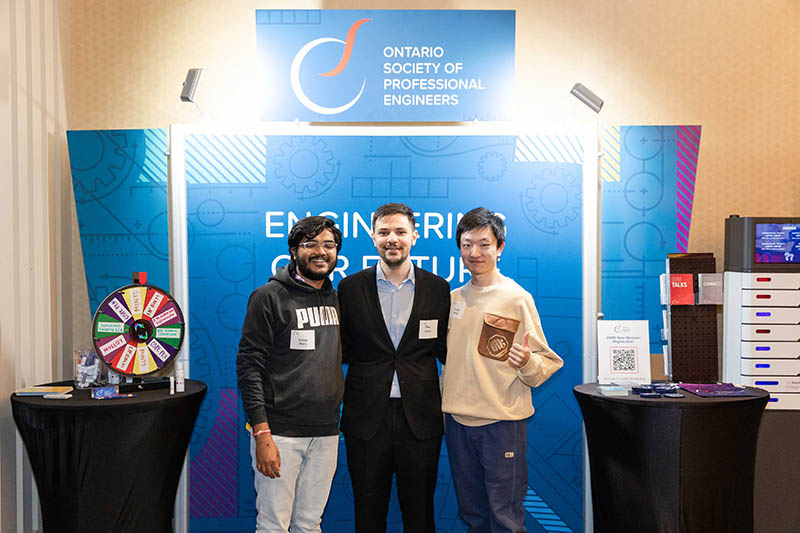
Three students from the University of Windsor at the OSPE booth during EngCon 2024 in Windsor, ON.
The post EngCon 2024: Conference Recap appeared first on Ontario Society of Professional Engineers.
]]>The post From Karun’s Heights to Hatch’s Horizons: Carl Bodimeade and Leila Jafari appeared first on Ontario Society of Professional Engineers.
]]>
From the rugged mountains of Iran to the bustling cities of Ontario, Carl Bodimeade and Leila Jafari’s engineering stories are woven together by their connection to the Karun Dam and their current careers at Hatch.
Carl, who serves as Senior VP at Hatch and is originally from the UK, worked on the Karun Dam project in Iran early in his career. “As part of my overseas work, I worked on the Karun Dam, which is on the Khusestan River in the southwest of Iran,” he explains. “It’s a 200-meter high dam in very mountainous terrain with a 2000-megawatt powerhouse. The purpose of the dam is power generation, flood control, and irrigation. Seeing that as a young engineer was quite an experience.”
This project was not only technically challenging but also logistically demanding. “When we were doing the geotechnical investigations, we had to move the drill rigs around by helicopter,” Carl recalls. “But during the Iran-Iraq war, helicopters were unavailable, so we had to break down the drill rig into parts and manually transport it to the top of the mountain. It was a very challenging site, but very rewarding.”
Leila’s connection to the Karun Dam came years later as an engineering student in Iran. “I got my inspiration from the very same dam,” she says. “As part of an educational field trip, our professor took us to see the dam. I was stunned by the height and scale of it. It was almost jaw-dropping for me as a young student. I decided then that I wanted to work for the company that designed it, which was Hatch.”
Prior to encountering the Karun dam, Leila’s engineering aspirations were influenced by her father, who was also an engineer. “My father brought work home and had us help with calculations,” she remembers. “I wanted to be like my dad. I was good at solving problems and meeting new people, which led me to engineering.”
After completing her studies at Shahid Chamran University of Ahvaz with a B.A.Sc. in Civil Engineering and then working for several years thereafter, Leila moved to Canada to continue her engineering career.
“When I came to Canada, I faced the challenge of understanding the work culture here,” she says. “The technical skills are the same, but the culture and teamwork are different. OSPE helped bridge that gap, providing opportunities for networking and mentorship.”
Both Carl and Leila found their professional homes at Hatch, a global engineering, project management, and professional services firm. “Hatch has been instrumental in our careers,” says Carl, who holds an M.Sc. in Soil Mechanics from Imperial College, London and a B.Sc. (Hons.) in Engineering Geology Newcastle University. “I moved to Canada and worked in Alberta before settling in Ontario with Hatch. My roles have varied from geotechnical to municipal water and wastewater engineering, and now strategy and business development across multiple sectors.”
Leila echoes Carl’s sentiments about Hatch. “Working at Hatch was a dream come true,” she says. “I faced challenges, such as gaining Canadian work experience, but Hatch and OSPE provided the support I needed. Being selected as one of the best mentors at Hatch was one of the most rewarding experiences of my career.”
Their work at Hatch often intersects with their past experiences. Carl, with his vast expertise in geotechnical and environmental engineering, and Leila, with her focus on project management and mentorship, both bring unique perspectives to their roles. “Our experiences in Iran, particularly with the Karun Dam, have shaped our engineering philosophies,” Carl notes. “The challenges we faced there taught us resilience and innovative problem-solving.”
Leila adds, “The Karun Dam project inspired me to pursue engineering, and now at Hatch, I can contribute to projects that have a lasting impact. It’s fulfilling to work on projects that not only solve technical problems but also improve communities.”
Their involvement with the Ontario Society of Professional Engineers (OSPE) has been a critical part of their professional development. “OSPE has been essential for networking and professional growth,” says Leila. “Through OSPE, I found mentors who helped me navigate the Canadian engineering landscape. Now, I give back by mentoring others, helping them integrate into the workforce.”
Both Carl and Leila emphasize the importance of professional networks and mentorship. “Networking is crucial in engineering,” Carl notes. “Through OSPE and Hatch, we have been able to build strong professional networks that have supported our career growth and development.”
Their work at Hatch allows them to leverage their diverse experiences and skills. Carl’s expertise in geotechnical and environmental engineering and Leila’s focus on project management and mentorship make them valuable assets to the firm. “Our work at Hatch often brings together our past experiences and current roles,” Carl says. “The projects we work on have a significant impact on communities, and it’s fulfilling to contribute to these projects.”
“Engineering is about solving problems and overcoming challenges,” Carl adds. “Our experiences in Iran, particularly with the Karun Dam, taught us valuable lessons that we apply to our work today.”
Leila says she always strives to pass on her experience through project management and mentorship. “Project management requires a balance of technical skills and interpersonal skills,” she explains. “Mentoring others is also a big part of my role. Helping new engineers integrate into the workforce and navigate their careers is something I am passionate about.”
“Engineering is about solving problems and overcoming challenges,” Carl notes. “Our experiences in Iran, particularly with the Karun Dam, taught us valuable lessons that we apply to our work today.”
Leila adds, “The Karun Dam project was a turning point for me. It inspired me to pursue a career in engineering, and now at Hatch, I can contribute to projects that have a lasting impact. It’s fulfilling to work on projects that improve communities and make a difference.”
Their stories are a testament to how early career experiences and challenges shape resilient, innovative engineers who continue to contribute significantly to their fields. At Hatch, they continue to build on their legacies, working on projects that matter while mentoring the next generation of engineers.
The post From Karun’s Heights to Hatch’s Horizons: Carl Bodimeade and Leila Jafari appeared first on Ontario Society of Professional Engineers.
]]>The post 5 ways to avoid having your car stolen appeared first on Ontario Society of Professional Engineers.
]]>
Did you know that a car is stolen every six minutes on average in Canada?
It’s easy to think that you’ll be immune to vehicle theft – but new and more advanced modes of theft and an increased scarcity of vehicles and parts is driving a significant increase in stolen vehicles across the country – and the scary reality is that you could be next.
The good news? By implementing these 5 simple and effective measures, you can reduce your risk of falling victim to this crime and avoid the headaches that come along with it, like increased premiums, added stress, and more.
1. Install an anti-theft tracking system
A vehicle anti-theft tracking and recovery system is one of the most effective defenses against theft. This type of system typically consists of a set of small wireless devices that are installed in your vehicle to help locate and recover it if it’s stolen anywhere in Canada or the United States. Many systems also include a discreet logo that’s engraved on both the windscreen of your vehicle and the most popular resale parts to further deter theft. Many only track your vehicle once you’ve reported it stolen, so you don’t have to worry about privacy concerns.
What’s even better? Installing an anti-theft tracking and recovery system could prevent you from having to pay a higher insurance premium if you drive a vehicle that’s at high risk of theft.
If your insurance company has recommended you install one, or you’re interested in getting one for your own peace of mind, look for a popular and reputable system like Tag Tracking, which can be installed at any local Speedy Glass location. Other reputable systems include KYCS Locate powered by Sherlock® or Domino Tracking©.
And don’t forget – once you’ve installed your anti-theft tracking system, let your insurance company know so they can record your tracking number and installation date.
2. Take additional precautions
In addition to installing an anti-theft system, it’s important to always lock your car (even if you’re only leaving it for a short period). Ensure that your doors, windows, and trunk are secure, and when parking your car, choose well-lit and populated areas since thieves are less likely to target vehicles in places with high visibility and foot traffic. Never leave your car running unattended and avoid leaving valuable items like your laptop, purse, or phone in plain sight.
3. Be mindful of your keys
Be cautious of keyless entry systems since thieves can intercept and clone the signals from your key fob to access your vehicle. You may also want to consider additional security measures, such as signal-blocking pouches to further prevent electronic key signal theft. Avoid leaving your keys unattended or in obvious places and, if you have a spare key, don’t hide it inside the car.
4. Consider driving a vehicle that is less of a target
Cars that are popular, easy to steal, or have high demand parts are more likely to be stolen. By choosing a vehicle that is less appealing to thieves, you minimize the chances of becoming a victim of car theft. Here’s a list of the top 5 stolen vehicles in Ontario in 2022 (from our own client data):
(Note: All models are 2017 are more recent)
- Range Rover
- Honda CR-V
- Toyota Highlander
- Dodge Ram 1500
- Lexus RX350
5. Add additional security features to your vehicle
You can also lower your car’s risk of being stolen by using things like:
- A steering wheel lock
- An on-board diagnostic (ODB) port lock
- Brake locks or audible alarms
Vehicle theft can be a scary and stressful topic, so it’s important to add as many layers of protection as you can to reduce your risk of being affected. Just remember, these tips are general in nature, and you should always consider your specific circumstances and location when taking preventive measures to keep yourself safe.
To find out more, call 1-888-476-8737.
Or visit thepersonal.com/ospe
This article is being provided by the Ontario Society of Professional Engineers on behalf of The Personal which has a group sponsorship agreement with regards to home and auto insurance for our members.
The Personal refers to The Personal General Insurance Inc. in Quebec and The Personal Insurance Company in all other provinces and territories of Canada. The information provided is meant to be illustrative only and does not constitute or replace the advice of experts. The Personal assumes no liability with regards to how such information is used.
The post 5 ways to avoid having your car stolen appeared first on Ontario Society of Professional Engineers.
]]>The post Unlocking Engagement, Equity, and Value in Small Engineering Firms appeared first on Ontario Society of Professional Engineers.
]]>Is a Lack of Structure Undermining Your Success?

In small firms that employ highly talented knowledge workers, roles can be flexible, which has its benefits, but it may create a belief that formal structure, leadership, and management are not (and even should not be) required.
In these cases, as the company grows there is a resulting gap that grows alongside it. A gap in leadership, strategy, accountability, and development.
The fallout from this is often evidenced by comments like “We have so much confusion in projects and priorities” or “I have to do a lot of re-work for more junior people because it’s just faster/easier that way”.
Other symptoms show up in the form of backed-up accounts receivable, or worse backed-up proposals and invoicing.
Owners often believe the problem is their team but hiring more people or “better people” isn’t the solution.
The solution is creating structure and implementing tools that engage your employees and support them to achieve at their highest level.
The Lever of Organizational Design
Engineering leaders can leverage tools from management science to achieve these next-level results, starting with Organizational Design (OD). Think of OD as a strategic fulcrum that leverages your firm’s success.
OD involves creating a formal structure—typically hierarchical or a matrix—that clearly defines roles, streamlines communication, promotes accountability, supports growth, and aligns employees with their strengths to achieve organizational goals.
It empowers key employees to work on the business rather than just in it, building the management layers needed to achieve targets and goals
The Value of Employee Engagement
Develop your employees and your business develops too.
The three most important requirements in employee engagement are:
- “I know what is expected of me.”
- “I have the resources I need to do my job.”
- “I get to do my best work every day.”

Engaged employees find purpose and meaning in their work. The elements that create engagement for them also result in positive results for your firm, including:
- greater productivity
- higher wellbeing
- better retention
- lower absenteeism
- increased safety
Each of these benefits leads to greater profit through reduced re-work and re-scheduling, higher quality results, lower recruitment and training costs, and less use of senior staff on lower-level tasks.
Engagement Pays Dividends
When contemplating placing people in management positions, there is often a fear of reducing billable hours – the fear that managers are eating revenue instead of producing it.
That concern is missing two key points:
- Management practices directly impact employee engagement and that leads to increased profits due to increased productivity and efficiency.
- All employees add value. For small professional services businesses, there is a business formula that each employee, client-serving or not, is equal to ~ $200,000 in revenue to your firm.
Here is how that return plays out: When managers build engagement, it builds both productivity (more billable hours) as well as efficiency (more profitable hours). Utilization rate by employee is relatively easy to measure. The ratio to measure for efficiency is Gross Margin (GM). GM = Revenue – Cost of Goods Sold (the majority of which is billable hours).
And of course, profit is the source for dividends.
While everyone recognizes that each owner employed in their business should earn a salary commensurate with the role that they fill, what gets missed is that in addition, every owner should earn an appropriate return on investment reflecting the risk they undertake in starting, operating and growing their business.
The impact of intentional OD on profitability cannot be overstated. It is the core mechanism that generates margin, builds the value of the business, and rewards ownership.
To Learn More:
- Stay tuned for the next blog post
- Visit the Tradewinds booth on October 29 at The Engineering Conference 2024 –where they’ll walk through a practical ROI and Valuation tool with you one-on-one.
- Join the Thought Leadership Thursday webinar. On November 7th. Tradewinds CFO, Jim Pelot is discussing “Value Sharing: Attracting, Incenting, Rewarding, and Retaining Employees.”
The post Unlocking Engagement, Equity, and Value in Small Engineering Firms appeared first on Ontario Society of Professional Engineers.
]]>